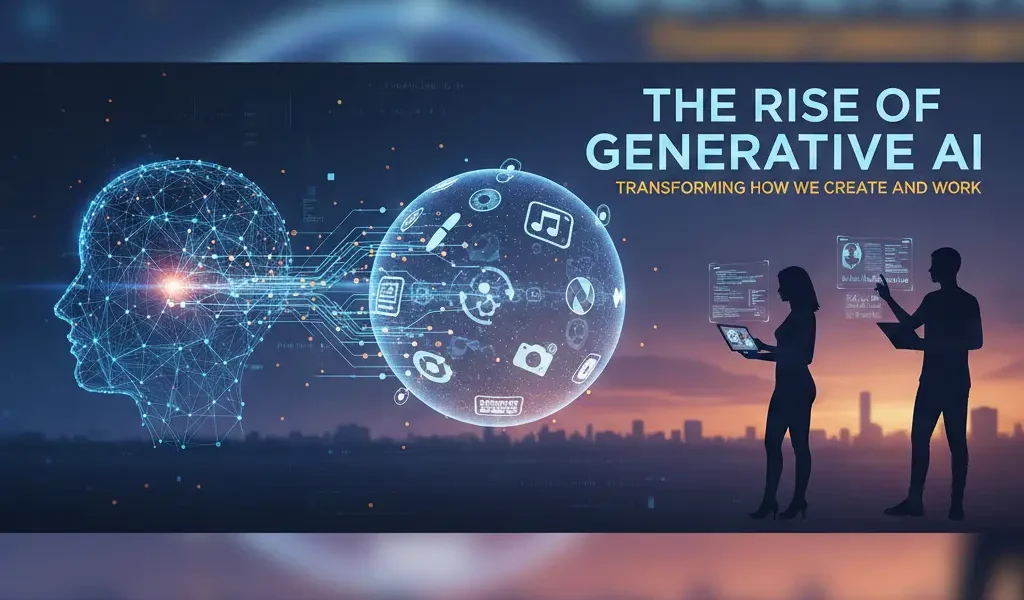
In the past decade, artificial intelligence (AI) has shifted from a niche field of computer science to a central force reshaping industries, economies, and everyday life. Among the most transformative advances within AI is Generative AI — a class of models that can create novel content rather than just analyze or classify existing data. Unlike traditional AI systems that make predictions (e.g., identify objects in images), generative models produce entirely new text, images, audio, and more based on patterns learned from data. These capabilities are revolutionizing creative work, scientific research, business automation, and human‑computer interaction.
What Is Generative AI? A Simple Explanation
At its core, generative AI refers to systems that generate output resembling human‑created content. These systems are trained on massive datasets — collections of text, pictures, audio clips, or other media — and they learn statistical patterns that allow them to predict and construct new sequences. Two common frameworks enabling generative AI are:
- Deep learning neural networks, especially transformer architectures, which excel at processing sequences like language.
- Generative Adversarial Networks (GANs), which consist of two competing models where one generates content and the other tries to distinguish real from fake.
The result is technology that can:
- Write essays, poems, and articles.
- Generate realistic photos of nonexistent people.
- Compose music or synthesize speech.
- Translate languages and summarize documents.
- Create code from natural language descriptions.
Examples of generative AI tools include large language models (LLMs), such as GPT series, and image generators trained on millions of visual examples.
Why Generative AI Matters Today
Generative AI is not just a research breakthrough — it’s becoming deeply embedded across sectors due to several key reasons:
1. Powerful Creativity at Scale
Traditional creativity often requires high levels of human skill, time, and iteration. Generative AI accelerates this by acting as an idea engine for writers, artists, and designers. For instance:
- A novelist can use AI to draft story ideas or character dialogues.
- A marketer can generate dozens of ad variations in minutes.
- A graphic designer can prototype visual concepts instantly.
This augmentation of creative tasks allows humans to focus on higher‑level decisions and storytelling — not just endurance‑based labor.
2. Productivity and Automation in the Workplace
Generative AI excels at tasks involving pattern recognition and structured output. Workers across industries are increasingly using it to:
- Draft emails and reports.
- Write or debug code.
- Produce data summaries and insights.
- Automate customer service responses using chatbots.
According to recent industry surveys, many professionals report that AI tools have multiplied their productivity — allowing them to accomplish in minutes what used to take hours.
3. Accessibility and Personalization
Generative AI is driving personalized experiences at scale. Education tools can adapt explanations to individual learning styles; health apps can summarize medical records in plain language; e‑commerce platforms can tailor product recommendations with narrative descriptions. This level of customization was previously too labor‑intensive to achieve for diverse audiences.
Breakthroughs Behind the Technology
Several technological innovations have fueled the rise of generative AI:
Transformers and Large Language Models
Transformer architectures — introduced in 2017 — process entire sequences of data rather than one element at a time. This enables models to learn contextual relationships across long spans of text. When trained on internet‑scale corpora, these models internalize many patterns of human language and reasoning.
Large language models (LLMs) like GPT‑3, GPT‑4, and beyond use this architecture to generate coherent and contextually relevant text. They can answer questions, continue prompts, and even explain their reasoning.
Unsupervised and Self‑Supervised Learning
Traditional machine learning required labeled examples (e.g., “this image contains a cat”). Generative AI uses self‑supervised learning — a method where the model learns from raw data by predicting parts of it (e.g., the next word in a sentence). This drastically reduces the need for manual labeling and allows training on vast datasets.
Multimodal Models
Recent research has expanded generative AI beyond text into multimodal models that understand and generate text, images, audio, and video together. This enables, for example, image captions with detailed descriptions or animated visuals generated from text prompts.
Applications Across Industries
Generative AI has broad real‑world applications that are already impacting how we work:
Education
AI tutors can provide personalized learning experiences, adapt explanations to student needs, and generate practice problems tailored to a learner’s skill level. Teachers can also use AI to produce lesson plans and grade assignments faster.
Medicine and Healthcare
In healthcare, generative models help with:
- Drafting clinical documentation.
- Summarizing patient records for physicians.
- Assisting in early diagnosis through pattern recognition in medical imagery.
Researchers are also using AI to explore new drug compounds — generating molecular structures that might be effective against diseases.
Entertainment and Media
AI is reshaping entertainment creation. Writers and game designers use generative models for world‑building ideas; animation studios explore AI‑assisted character design; and musicians experiment with AI‑generated melodies and harmonies. Even newsrooms are trialing AI to draft routine reporting while human journalists focus on investigation and analysis.
Business Insights and Decision Making
AI systems digest large datasets to produce strategic insights. Executives use these tools to forecast trends, analyze risks, and simulate scenarios — all in natural language that’s easy to understand. This accelerates management workflows and supports data‑driven decisions.
Challenges and Concerns
Despite its promise, generative AI raises important concerns:
Misinformation and Authenticity
AI can produce plausible but false information — known as “hallucinations” — creating risks for misinformation. Bad actors may also deploy AI to generate realistic fake media (text, audio, and images) to deceive audiences.
Bias and Fairness
Models trained on real‑world data can reflect and amplify societal biases — producing content that reinforces stereotypes or discriminates against groups. Addressing these biases requires careful dataset curation and ethical guardrails.
Copyright and Ownership Issues
Generative AI often learns from existing creative works, raising questions about intellectual property. Who owns the content created by AI? Are the original data sources properly credited and compensated? These are ongoing legal debates.
Job Displacement Fears
There is concern that automation may reduce demand for certain types of labor, particularly repetitive writing, graphic design, or coding tasks. However, many experts emphasize that AI is more likely to augment human roles rather than replace them entirely — especially for tasks requiring nuance, empathy, and complex judgment.
Ethics, Governance, and the Future
The rapid advancement of generative AI demands responsible governance. Many organizations and governments are now:
- Setting ethical guidelines for AI use.
- Funding research into AI safety and interpretability.
- Exploring regulatory frameworks to protect users and ensure transparency.
Industry leaders stress the importance of human‑in‑the‑loop systems — where AI assists but humans remain in control of critical decisions.
Looking ahead, the future of generative AI is expansive. We may see:
- AI companions that enhance mental health support.
- Seamless language translation in real‑time conversations.
- Collaborative creative studios powered by AI co‑creators.
- AI systems that help solve scientific mysteries we have yet to imagine.
Conclusion
Generative AI represents a fundamental shift in how machines can assist human creativity, productivity, and problem‑solving. It is not just a new tool but a new paradigm that blends computation with imagination. While challenges remain — including fairness, safety, and ethical deployment — the potential benefits are profound. As the technology matures, society will need thoughtful collaboration between technologists, policymakers, creators, and everyday users to unlock its promise responsibly.