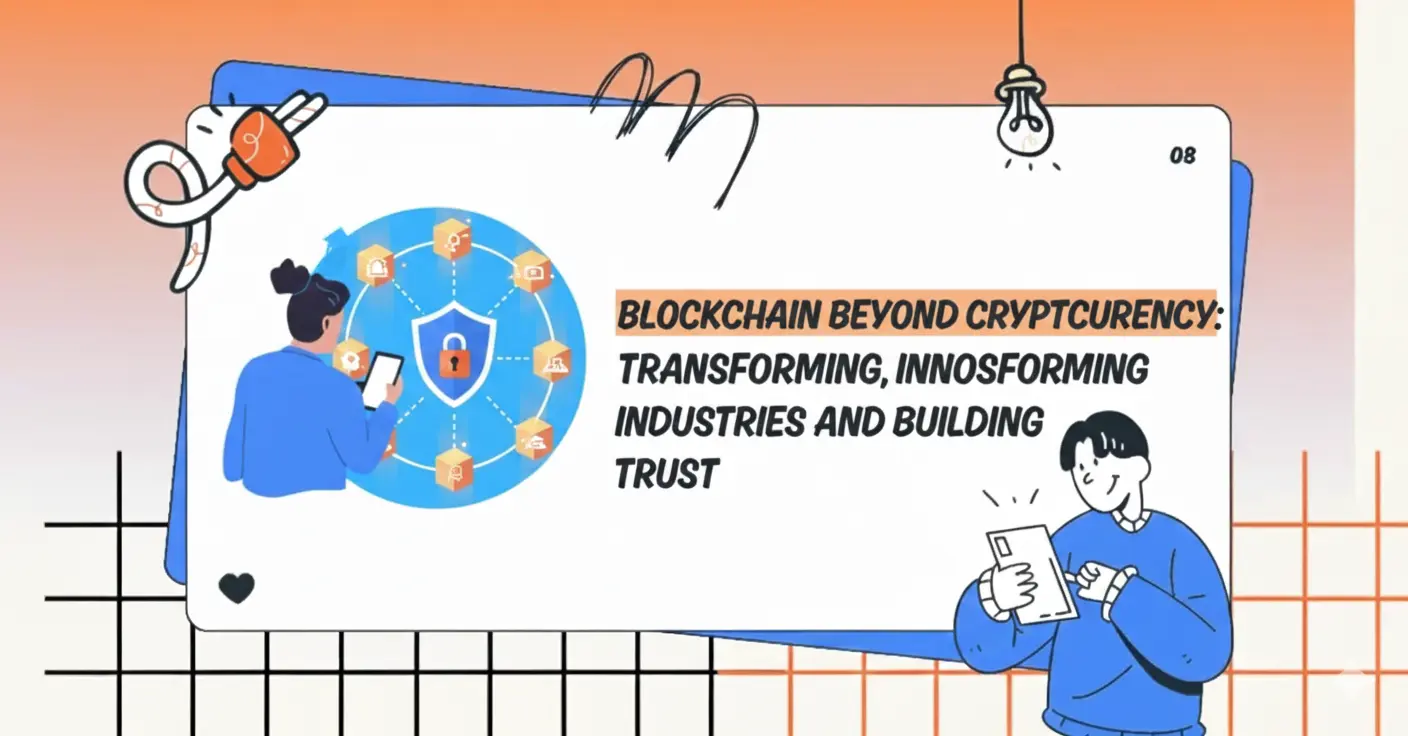
When blockchain technology first emerged as the backbone of Bitcoin in 2009, it was widely associated with cryptocurrencies and the speculative markets surrounding them. Over the past decade, however, blockchain has evolved far beyond digital currency. At its core, blockchain is a decentralized, tamper-proof digital ledger that enables secure, transparent, and verifiable record-keeping without the need for a central authority. This characteristic has immense potential for transforming industries, improving transparency, and enabling innovative applications in areas as diverse as supply chain management, finance, healthcare, and governance.
This article explores the foundations of blockchain technology, its real-world applications, challenges, and future potential beyond cryptocurrencies.
Understanding Blockchain Technology
Blockchain is essentially a distributed database where information is recorded in blocks that are chronologically linked and cryptographically secured. Key features include:
- Decentralization: Unlike traditional databases managed by a single authority, blockchain data is stored across multiple nodes. This reduces the risk of a single point of failure or manipulation.
- Immutability: Once a block is added to the blockchain, it cannot be altered retroactively without changing all subsequent blocks, which would require consensus from the majority of the network. This ensures data integrity.
- Transparency and Traceability: Every participant in a blockchain network can verify transactions. In public blockchains, data is visible to anyone; in private blockchains, permissions control access.
- Consensus Mechanisms: Blockchain uses mechanisms like Proof of Work (PoW), Proof of Stake (PoS), and other algorithms to ensure that all nodes agree on the validity of transactions.
These characteristics make blockchain ideal for applications that require trust, accountability, and decentralized verification.
Applications of Blockchain Beyond Cryptocurrency
While cryptocurrency remains the most well-known application, blockchain is now being applied across industries in innovative ways.
1. Supply Chain Management
Supply chains are often complex and fragmented, with multiple parties handling raw materials, production, and distribution. Blockchain provides end-to-end transparency, enabling stakeholders to:
- Track the origin of goods and verify authenticity.
- Reduce fraud and counterfeit products.
- Automate payments and contractual obligations through smart contracts.
For example, in the food industry, blockchain can track produce from farm to table, ensuring quality and safety while improving accountability. Retail giants and logistics companies are increasingly adopting blockchain to streamline operations and build consumer trust.
2. Healthcare and Medical Records
Healthcare systems face challenges in data interoperability, patient privacy, and record accuracy. Blockchain can:
- Securely store patient records that are accessible only to authorized parties.
- Track the supply of pharmaceuticals to prevent counterfeit drugs.
- Facilitate research by providing verified, anonymized datasets while maintaining privacy compliance.
By providing a tamper-proof audit trail, blockchain enhances trust in sensitive medical information and supports better patient outcomes.
3. Digital Identity Verification
Digital identity management is another promising use of blockchain. Traditional systems are often centralized, vulnerable to hacks, and reliant on multiple third-party verification services. Blockchain-based identities allow individuals to own and control their personal data, selectively sharing information with trusted parties. Benefits include:
- Reducing identity theft and fraud.
- Enabling secure access to online services.
- Supporting KYC (Know Your Customer) processes in finance.
This concept of self-sovereign identity could transform how governments, corporations, and individuals manage personal information.
4. Smart Contracts
Smart contracts are self-executing contracts with the terms of the agreement written into code and stored on a blockchain. They automatically enforce agreements when pre-defined conditions are met, removing the need for intermediaries. Applications include:
- Real estate transactions that execute automatically when payments and legal conditions are verified.
- Insurance claims processed instantly upon verification of an event, such as a flight delay or accident.
- Supply chain automation for payments, shipment releases, or inventory management.
Smart contracts improve efficiency, reduce errors, and minimize the risk of disputes.
5. Decentralized Finance (DeFi) and Beyond
DeFi leverages blockchain to provide financial services — lending, borrowing, trading, and insurance — without traditional banks. DeFi platforms operate through smart contracts, offering:
- Greater financial accessibility, especially in regions with limited banking infrastructure.
- Lower transaction costs compared to conventional financial intermediaries.
- Transparency and verifiability of transactions.
Beyond DeFi, blockchain enables tokenization of assets, where real-world assets like real estate, art, or commodities are represented digitally on a blockchain. This opens up new possibilities for fractional ownership and liquidity.
6. Voting and Governance
Blockchain-based voting systems are being explored for secure, transparent, and tamper-resistant elections. By recording votes on a blockchain:
- Voter fraud can be minimized.
- Results are verifiable by all stakeholders.
- Election transparency and public trust are increased.
Blockchain governance also extends to organizational decision-making, where stakeholders can vote on proposals with immutable records of participation.
Challenges and Limitations
Despite its potential, blockchain faces several challenges that must be addressed for widespread adoption:
1. Scalability
Traditional blockchain networks like Bitcoin or Ethereum face limits on transaction throughput. High demand can lead to congestion and increased costs. Layer-2 solutions, sharding, and alternative consensus algorithms are being developed to improve scalability.
2. Energy Consumption
Proof-of-Work blockchains consume significant energy due to the computational power required for mining. This has environmental implications. Proof-of-Stake and other low-energy consensus mechanisms are increasingly adopted to mitigate this issue.
3. Regulatory Uncertainty
Governments are still developing frameworks to regulate blockchain applications. Issues around taxation, data privacy, and legal recognition of smart contracts remain unresolved in many jurisdictions.
4. Interoperability
With multiple blockchain platforms operating independently, interoperability is a challenge. Efforts to create cross-chain protocols and standardized frameworks aim to ensure seamless communication between networks.
5. Complexity and Adoption Barriers
Blockchain requires technical expertise for deployment and maintenance. Many organizations face challenges in integrating blockchain with legacy systems or understanding its practical applications.
Emerging Trends in Blockchain
The blockchain ecosystem continues to evolve rapidly, with several notable trends:
- Enterprise Adoption: Large corporations are increasingly exploring private and consortium blockchains for internal processes, supply chain management, and digital identity.
- Integration with IoT and AI: Combining blockchain with IoT ensures secure, verifiable data from devices, while AI can analyze this data for insights and automation.
- Central Bank Digital Currencies (CBDCs): Many countries are experimenting with blockchain-based digital currencies to enhance efficiency, traceability, and financial inclusion.
- Non-Fungible Tokens (NFTs) Beyond Art: NFTs are expanding into intellectual property, gaming, real estate, and digital collectibles as a method for proving ownership and provenance.
- Blockchain-as-a-Service (BaaS): Cloud providers are offering blockchain platforms as a service, reducing technical barriers for organizations to deploy blockchain applications.
The Future of Blockchain
The true potential of blockchain lies in its ability to enable trust in decentralized systems. By removing reliance on intermediaries, providing transparency, and securing data, blockchain can reshape industries and create new business models. Future developments are likely to focus on:
- Scalable, energy-efficient consensus mechanisms to support mass adoption.
- Cross-industry interoperability for seamless collaboration between platforms.
- Wider adoption in public sector applications, such as healthcare, voting, and social services.
- Integration with emerging technologies like IoT, AI, and edge computing for smarter ecosystems.
As organizations and governments experiment with blockchain beyond cryptocurrencies, we are entering an era where trust, verification, and decentralization are built into the fabric of digital infrastructure.
Conclusion
Blockchain is much more than the foundation of Bitcoin or other cryptocurrencies. Its unique characteristics — decentralization, immutability, transparency, and security — make it a transformative technology with applications across supply chains, healthcare, finance, governance, and beyond. While challenges such as scalability, energy use, regulatory uncertainty, and technical complexity exist, ongoing innovation and experimentation continue to unlock its potential.
The rise of blockchain beyond cryptocurrency signals a shift toward trust-based digital ecosystems, where intermediaries are minimized, accountability is transparent, and verification is built into the technology itself. As businesses, governments, and individuals explore its capabilities, blockchain promises to redefine how we manage information, conduct transactions, and build trust in the digital age.
The journey has only just begun, and blockchain’s impact is poised to expand far beyond what we currently imagine, creating a future that is transparent, secure, and decentralized.